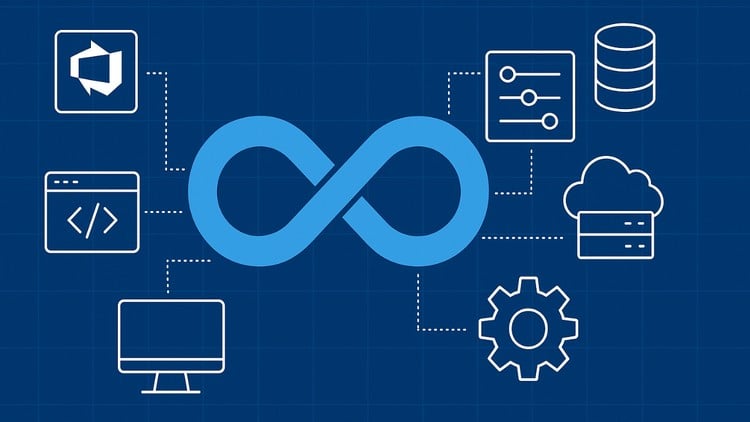
Overview
Understand the core principles of DevOps, CI/CD, and Agile methodologies., Explain the components, architecture, and key features of Azure DevOps., Set up and manage Azure DevOps projects, repositories, and dashboards., Create and track work items, user stories, epics, and tasks using Azure Boards., Configure and manage sprints, backlogs, and workflows for Agile project delivery., Establish relationships between work items to manage dependencies effectively., Build and automate Classic build pipelines using the Azure DevOps Classic Editor., Configure build triggers, variables, and reusable task groups for efficiency., Design and implement Continuous Deployment (CD) pipelines for automated releases., Create service connections and service principals to enable secure deployments., Configure release pipelines for different stages and environments., Work with deployment groups to orchestrate distributed deployments., Develop CI/CD automation using YAML pipelines with multi-stage configuration., Manage environment approvals, conditional deployments, and branch-based releases., Deploy applications to Azure App Services and Virtual Machines., Configure and manage both Microsoft-hosted and self-hosted build agents., Optimize job execution, parallel runs, and pipeline performance., Implement retention policies and manage artifacts effectively., Use the Azure DevOps Library for variables, secrets, and shared resources., Manage pipeline permissions and access controls for governance and compliance., Apply best practices for secure, scalable, and maintainable DevOps workflows., Gain practical, end-to-end experience in building real-world CI/CD pipelines., Prepare for roles such as Azure DevOps Engineer, Build & Release Engineer, or Cloud Automation Specialist.
Software Developers & Engineers – who want to automate build, test, and deployment workflows directly from code repositories., DevOps Engineers & Release Managers – aiming to design and manage robust CI/CD pipelines, automate deployments, and monitor releases., System Administrators & Cloud Engineers – responsible for maintaining infrastructure and deploying applications across environments using Azure Pipelines., QA Engineers & Test Automation Specialists – looking to integrate automated testing into continuous integration and deployment processes., Project Managers & Scrum Masters – who wish to understand Agile Boards, sprints, and tracking mechanisms within Azure DevOps., Solution Architects & Technical Leads – interested in establishing governance, scalability, and best practices in DevOps environments., Students & Aspiring IT Professionals – who want to enter the DevOps and Cloud Engineering domain with real-world, hands-on skills., IT Teams Transitioning to Azure – seeking to migrate their CI/CD workflows, repositories, and release management to the Azure DevOps ecosystem., Organizations Adopting DevOps Culture – aiming to upskill their workforce for faster, reliable, and automated delivery cycles.
Enthusiasm and determination to make your mark on the world!
A warm welcome to Azure DevOps for CI/CD Pipelines and Automation course by Uplatz.
What is Azure DevOps?
Azure DevOps is a cloud-based platform developed by Microsoft that provides a comprehensive suite of tools to manage the entire software development lifecycle (SDLC) — from planning and coding to building, testing, releasing, and monitoring applications.
It enables teams to collaborate efficiently, adopt DevOps practices, and implement Continuous Integration (CI) and Continuous Delivery (CD) to achieve faster, more reliable, and automated software delivery.
Azure DevOps unifies development, operations, and project management into one environment. It supports multiple programming languages, frameworks, and deployment targets, whether on-premises or in the cloud.
How Azure DevOps Works
Azure DevOps functions through a set of integrated services that cover each stage of the development and delivery process.
1. Azure Repos
A version control system that manages source code repositories.
Supports both Git (distributed) and TFVC (centralized) version control.
Enables collaboration through branching, merging, and pull requests.
2. Azure Boards
A work tracking system that supports Agile, Scrum, and Kanban methodologies.
Allows teams to plan, track, and manage work with user stories, tasks, and backlogs.
Provides reporting dashboards and analytics for project progress.
3. Azure Pipelines
The CI/CD automation engine of Azure DevOps.
Build Pipelines (CI): Automatically compile, test, and package code on every commit.
Release Pipelines (CD): Deploy builds to multiple environments such as development, staging, and production.
Supports both YAML-based and Classic editor pipeline definitions.
Offers Microsoft-hosted or self-hosted agents for build and deployment execution.
4. Azure Test Plans
A complete testing solution for manual and automated tests.
Helps manage test cases, capture defects, and integrate testing into CI/CD workflows.
5. Azure Artifacts
A package management system for storing and sharing build outputs.
Supports NuGet, npm, Maven, and Python packages.
Enables dependency and version management across multiple projects.
Typical Azure DevOps Workflow
Plan – Define requirements, user stories, and tasks using Azure Boards.
Code – Write and manage source code in Azure Repos.
Build (CI) – Automate builds and testing using Azure Pipelines.
Release (CD) – Deploy automatically to different environments through Release Pipelines.
Monitor and Improve – Analyze metrics, track defects, and continuously enhance the process.
Why Organizations Use Azure DevOps
Provides a unified platform for collaboration between development, testing, and operations teams.
Integrates seamlessly with Microsoft Azure, as well as AWS, Google Cloud, and on-premise environments.
Supports automation, scalability, and governance across enterprise pipelines.
Facilitates the adoption of Agile and DevOps cultures, resulting in faster releases and improved software quality.
Course Description
Learn how to design, build, and automate complete DevOps workflows using Azure DevOps, Microsoft’s unified platform for Continuous Integration and Continuous Delivery (CI/CD).
This course takes you step-by-step from DevOps fundamentals to advanced pipeline automation, covering real-world implementation across Azure Boards, Repos, Pipelines, Test Plans, and Artifacts.
You will gain hands-on experience in creating both Classic and YAML-based pipelines, configuring agents, automating builds and deployments, and applying governance through permissions, retention, and environment approvals.
By the end of the course, you’ll be able to manage end-to-end CI/CD processes, integrate Agile project management, and deliver faster, more reliable software releases using Azure DevOps.
What you’ll learn
Understand DevOps principles and how Azure DevOps supports CI/CD.
Create and manage projects, repositories, and dashboards in Azure DevOps.
Build and automate Classic and YAML-based pipelines.
Configure triggers, variables, and task groups for efficient builds.
Deploy applications to Azure App Service and virtual machines.
Implement multi-stage deployment pipelines with environment approvals.
Integrate Agile workflows using Azure Boards for sprint and backlog management.
Configure Microsoft-hosted and self-hosted build agents.
Manage permissions, retention policies, and shared libraries.
Apply best practices for governance, security, and scalability in Azure DevOps environments.
Who this course is for
Developers and DevOps Engineers looking to automate build and release pipelines.
System Administrators and Cloud Engineers managing deployments across environments.
QA and Test Automation Engineers integrating continuous testing in CI/CD pipelines.
Project Managers, Scrum Masters, and Agile practitioners who want to manage sprints and track progress using Azure Boards.
Technical Leads and Solution Architects designing scalable and secure CI/CD frameworks.
Students and aspiring IT professionals preparing for Azure DevOps roles or certifications.
Azure DevOps for CI/CD Pipelines and Automation - Course Curriculum
Module 1: Foundations of DevOps & Azure DevOps
Lecture 1 – Introduction to DevOps
Lecture 2 – Introduction to Azure DevOps
Lecture 3 – Key Features of Azure DevOps
Lecture 4 – Tools and Project Life Cycle
Lecture 5 – Getting Started with Azure DevOps
Module 2: Agile Project Management with Azure Boards
Lecture 6 – Understanding Azure Boards Process
Lecture 7 – Managing Work Items
Lecture 8 – Linking Work Items (Parent–Child Relationships)
Lecture 9 – Sprint Planning and Execution
Module 3: Classic Build Pipelines
Lecture 10 – Introduction to Classic Build Pipelines
Lecture 11 – Understanding the Build Process
Lecture 12 – Creating Pipelines using the Classic Editor
Lecture 13 – Classic Pipeline Creation and Configuration
Lecture 14 – Manual Classic Pipeline Creation and Adding Tasks
Lecture 15 – Configuring Classic Pipeline Triggers
Lecture 16 – Working with Task Groups
Module 4: Continuous Deployment (CD) Pipelines
Lecture 17 – Introduction to Continuous Deployment Pipelines
Lecture 18 – Creating Azure App Service for CD Pipelines
Lecture 19 – Setting up Service Connections & Service Principals
Lecture 20 – Creating Release Pipelines (Part 1)
Lecture 21 – Creating Release Pipelines (Part 2)
Lecture 22 – Working with Deployment Groups (Part 1)
Lecture 23 – Working with Deployment Groups (Part 2)
Module 5: YAML Pipelines
Lecture 24 – YAML Pipeline Fundamentals (Part 1)
Lecture 25 – YAML Pipeline Implementation (Part 2)
Lecture 26 – YAML Pipeline Advanced Concepts (Part 3)
Lecture 27 – Multi-Stage YAML Pipelines
Lecture 28 – Multi-Stage YAML Pipelines with Environment Approvals
Lecture 29 – Deploying Applications to Virtual Machines
Lecture 30 – Environment-Specific Deployments Based on Branches
Module 6: Agents, Jobs, and Execution
Lecture 31 – Introduction to Build & Release Agents
Lecture 32 – Microsoft-Hosted Agent Deep Dive
Lecture 33 – Self-Hosted Agent Configuration
Lecture 34 – Jobs Deep Dive and Best Practices
Module 7: Administration & Governance
Lecture 35 – Retention Policies in Azure DevOps
Lecture 36 – Managing the Library in Pipelines
Lecture 37 – Managing Pipeline Permissions (Part 1)
Lecture 38 – Managing Pipeline Permissions (Part 2)
Uplatz Training
Uplatz is UK-based leading IT Training provider serving students across the globe. Our uniqueness comes from the fact that we provide online training courses at a fraction of the average cost of these courses in the market.
Within a short span of 6 years, Uplatz has grown massively to become a truly global IT training provider with a wide range of career-oriented courses on cutting-edge technologies and software programming.
Our specialization includes Data Science, Machine Learning, Deep Learning, Data Engineering, AWS, SAP, Oracle, Salesforce, Microsoft Azure, GCP, DevOps, SAS, Python, R, JavaScript, Java, C, C++, Full Stack Web Development, Angular, React, NodeJS, Django, IoT, Cybersecurity, BI & Visualization, Tableau, Power BI, Data warehousing, ETL tools, ServiceNow, Software Testing, RPA, Embedded Engineering, Automotive Engineering, DSP, VHDL, Microcontrollers, Electronics, Computer Hardware Engineering, MATLAB, Digital Marketing, Product Marketing, Finance, Accounting, Tally, and more.
Founded in March 2017, Uplatz has seen phenomenal rise in the training industry providing training on 300+ self-paced courses and 5000+ tutor-led courses across 180 countries having served 1.5 million students in a period of just a few years.
Uplatz's training courses are highly structured, subject-focused, and job-oriented with strong emphasis on practice and assignments. Our courses are designed and taught by highly skilled and experienced instructors who have strong expertise in varied fields whether it be Cloud Computing, SAP, Oracle, Salesforce, Programming Languages, Web Development, or any other technology and in-demand software.