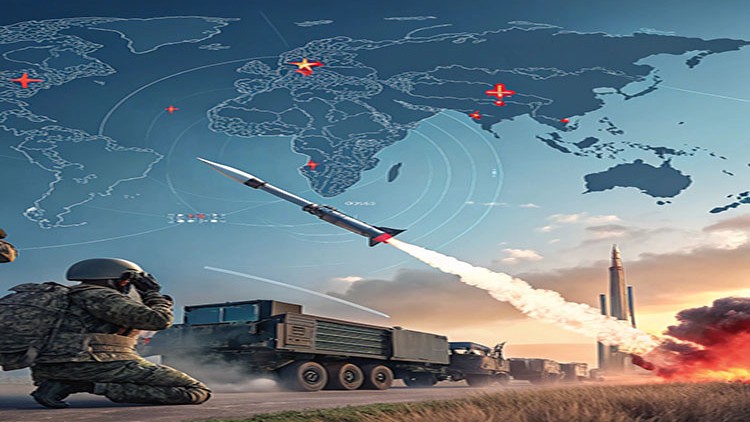
Overview
Introduction to Missile Technology and Classification, Ballistic vs. Cruise Missiles, Missile Aerodynamics and Structures, Propulsion Systems: Solid, Liquid, Ramjet, and Hypersonic, Guidance, Navigation, and Control (GNC) Systems
engineers, and analysts seeking to understand modern missile systems, strategic applications, and regional conflict dynamics., Aerospace and Defense Engineering Students University students and graduate-level learners in aerospace, mechanical, or systems engineering interested in propulsion, guidance, and missile design., Security and Strategic Studies Professionals Researchers, diplomats, policy analysts, and geopolitical consultants examining the impact of missile technology on regional and global stability.
basic knowledge of physics – especially mechanics and motion, Familiarity with military or geopolitical concepts, Comfort with technical diagrams and military system terminology
Missile technology lies at the core of modern military power, strategic deterrence, and aerospace innovation. This comprehensive course offers a structured, systems-level exploration of how missile systems are conceived, designed, guided, powered, defended against, and strategically employed. It is designed to move learners from fundamental principles to advanced concepts, integrating engineering theory with real-world defense applications and contemporary case studies.
The course begins with missile classification and historical evolution, clarifying the differences between ballistic, cruise, and hypersonic missiles. Learners then examine missile aerodynamics and structural design, followed by an in-depth study of propulsion technologies including solid and liquid rocket motors, turbojet, ramjet, and scramjet systems. Guidance, Navigation, and Control systems are covered in detail, including inertial navigation, GPS, radar, infrared, laser guidance, and the growing role of artificial intelligence and real-time data processing.
Advanced modules address warhead technologies, comparing conventional and strategic payloads, as well as missile defense architectures such as Iron Dome, THAAD, S-400, and early warning networks. The course also explores strategic missile systems including ICBMs, SLBMs, and MIRVs, along with stealth technologies, decoys, and electronic warfare. Global missile programs, strategic doctrines, and the geopolitical, ethical, and legal dimensions of missile technology are examined to provide a balanced and responsible perspective.
This course is intended for aerospace and mechanical engineering students, defense and military professionals, researchers in security and strategic studies, and advanced learners with a strong interest in missile systems. It is not suitable for beginners without a technical background or for anyone seeking operational or weapon construction instructions.
Mohamed AL ashram
My name is Mohamed Al Ashram. As an author, instructor, and veterinarian, I am deeply passionate about medicine, science, and technology. Reading and writing are not just hobbies for me; they are my true joys. With a medical background and a degree in veterinary medicine, along with postgraduate studies in microbiology, biochemistry, and genetics, I find endless motivation in learning and teaching.
Teaching is not merely a job; it’s a responsibility and a mission. It’s about transferring knowledge and experience to our sons and daughters, our colleagues, and our students. I believe that every lesson learned is a stepping stone toward a brighter future. Through education, we can inspire curiosity, foster innovation, and cultivate the next generation of thinkers and doers. That’s what drives me every day.