Overview
Define sustainability and understand the connections between its three pillars: environmental, social, and economic., Analyze the economic impact on sustainability and the challenges to implementing positive change., Identify ways to foster responsible economic growth while considering environmental constraints and social equity., Learn about institutional and individual responsibilities for creating a sustainable future.
Students and professionals in economics, environmental science, and social studies., Anyone interested in learning about sustainable development and its economic impact.
Basic understanding of economic principles and concepts., Interest in sustainability and its global implications.
In today’s interconnected world, sustainability is a critical issue that affects every aspect of our lives. "Understanding Economic Sustainability: Balancing Growth and Responsibility" is a comprehensive course designed to provide students with a thorough understanding of the economic pillar of sustainability and its critical role in shaping a sustainable future.
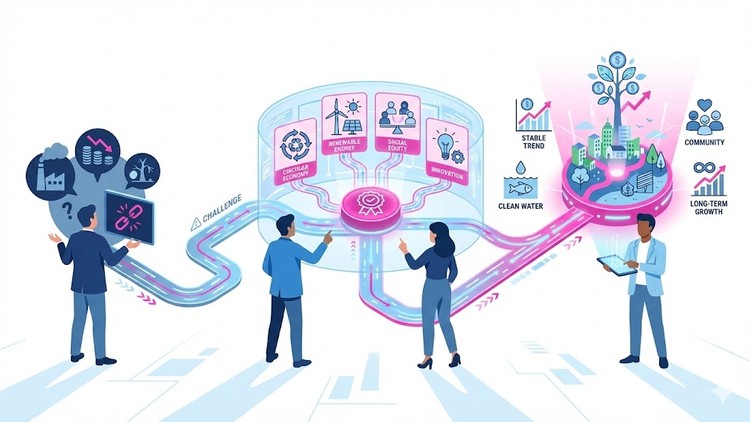
Sustainability refers to the idea that humans must utilize Earth’s resources in ways that allow all life to co-exist and thrive, both now and in the future. The concept rests on three interdependent pillars: environmental, social, and economic. Each pillar is equally crucial, supporting and being supported by the others. This course focuses specifically on economic sustainability, examining its definition, significance, challenges, and strategies for implementation.
At the outset, you will learn about the current state of global economic health. Economic growth worldwide largely hinges on resource consumption. However, many resources, such as fossil fuels, are finite and are being used irresponsibly. Renewable resources, like trees, are consumed at rates faster than they can be replenished. This unsustainable consumption poses severe risks to both environmental and social stability. We need a balanced approach where economic prosperity, community well-being, and environmental resilience are achieved together.
Next, the course will delve into defining economic sustainability. Economic sustainability encompasses economic development, job creation, fair compensation, labor rights, and the circular economy, which promotes the reuse and regeneration of materials and products. This pillar enables society to innovate, solve problems, and improve living standards. However, it must be pursued in harmony with environmental and social goals, emphasizing responsible resource usage while minimizing negative impacts on the environment and society.
Understanding economic sustainability's importance is another key aspect covered in this course. A diverse, positive, and inclusive work culture enhances economic sustainability, leading to growth in jobs, green technology, and infrastructure. Equitable treatment of workers, ensuring their safety, fair treatment, and living wages, also play crucial roles.
You will explore how economic sustainability impacts the other pillars of sustainability. Economic changes such as eliminating poverty, encouraging responsible resource consumption, and meeting society’s needs can significantly improve social well-being. However, as people become wealthier, their resource consumption tends to increase, leading to negative environmental impacts. Ignoring environmental sustainability risks ecosystem collapse, highlighting the need for balance.
The course addresses the challenges of economic sustainability, including social inequity, the high costs of green technology and infrastructure, poverty, responsible resource management, political instability, and climate change. These challenges prompt crucial questions: How can we enhance living standards and create economic prosperity without compromising our environment? What will drive changes in our behaviors, culture, and policies toward sustainability?
Implementing change is a multi-level effort involving individuals, corporations, and institutions. Each must consider the environmental and social impacts when implementing policies, strategies, and behavioral changes. Corporate responsibility, in particular, plays a significant role. Businesses can promote an equitable workplace by integrating diversity and inclusion initiatives and providing living wages and benefits. Investing in green technology research and development, adopting manufacturing processes using renewable energy, conserving water, and reducing waste are practical corporate steps towards economic sustainability.
By the end of this course, you will possess a nuanced understanding of economic sustainability and its broader implications. You will be better equipped with knowledge and strategies to foster sustainable economic growth in ways that respect and protect our environment and society.
GURUCAN Institute
Gurucan, an international training and consulting platform, offers businesses and individuals the opportunity to create and sell online courses, as well as provide consulting services. The platform includes a wide range of features such as course creation, student management, online payments, live webinars, and more. Its ultimate goal is to simplify and optimize the training and consulting process by providing a comprehensive and user-friendly platform.
At Gurucan, we specialize in training and international consulting services, designed to help individuals and organizations thrive in today's global marketplace. Whether you're an individual looking to enhance your skills in a specific area or a company seeking guidance on expanding into new markets, we have the expertise to support you.
Our training programs are tailored to meet the unique needs of each client. From leadership development to cross-cultural communication, we offer practical and actionable strategies that can be immediately applied in real-world situations. Additionally, our consulting services cover everything from market research and analysis to the development of market entry strategies, helping you make informed decisions and minimize risks.
With our deep understanding of diverse cultures and business practices, we can effectively bridge the gap between different markets and facilitate successful cross-border collaborations. Our ultimate objective is to empower individuals and organizations with the knowledge and skills necessary to thrive in today's global economy.